Welcome back to the blog! Today, we’re stepping away from the “what AI can do” conversation and digging into how we got here in the first place. Artificial intelligence didn’t appear overnight, and it certainly didn’t start with chatbots or automation platforms. It evolved through decades of experimentation, false starts, breakthroughs, and shifting ideas about what it even means for a machine to be “intelligent.” Get comfortable—this one’s a journey.
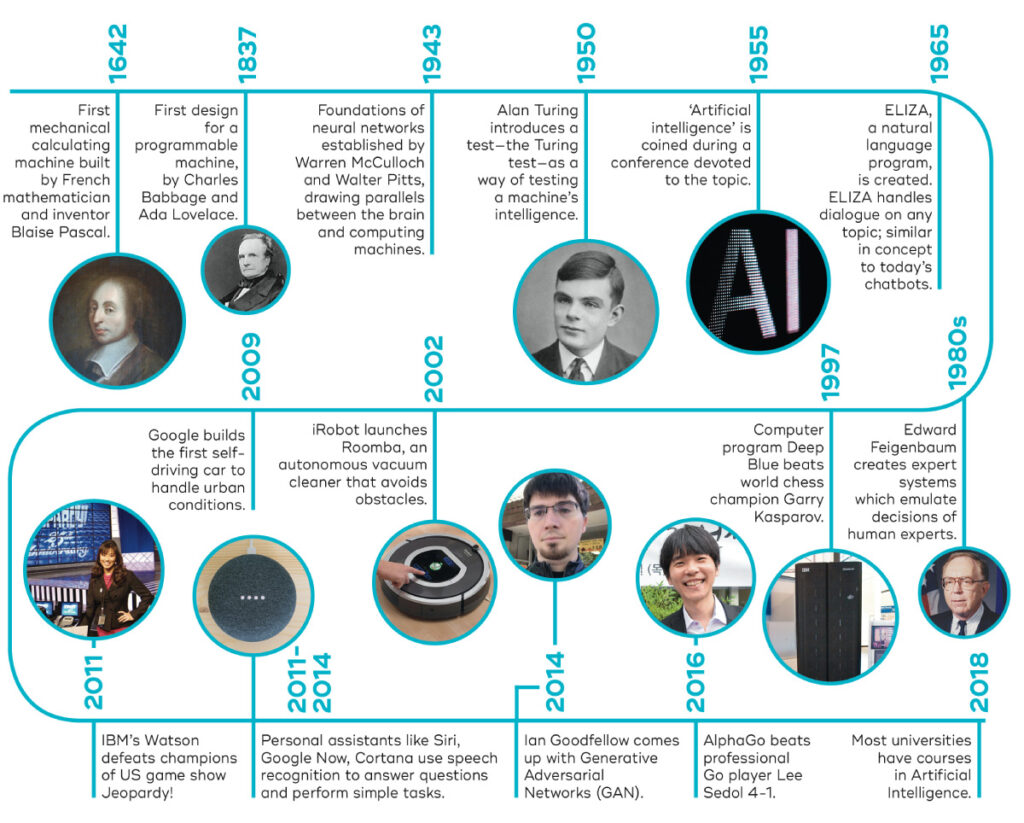
Artificial intelligence began as a thought experiment long before it became a business tool. Early researchers were fascinated by a simple question: could a machine be made to think like a human? In the earliest days, the answer seemed straightforward. If human intelligence followed rules, then intelligence could be recreated by writing those rules down. This belief shaped the first era of AI, known today as rule-based systems.
In rule-based AI, everything depended on logic. Developers created large sets of “if–then” statements that told computers exactly what to do in specific situations. These systems worked well in tightly controlled environments, such as mathematical problem-solving or structured decision trees. However, they struggled the moment real-world complexity entered the picture. Human behavior, language, and decision-making turned out to be far messier than a static list of rules could handle.
As expectations outpaced results, enthusiasm cooled. This led to periods often referred to as “AI winters,” when funding dried up and progress slowed. But behind the scenes, researchers were quietly rethinking the approach. Instead of telling machines how to think, what if machines could learn?
That shift marked the rise of machine learning. Rather than relying on hand-coded rules, machine learning systems analyze data, identify patterns, and improve their performance over time. The more data they see, the better they get. This was a turning point. AI no longer needed to be explicitly programmed for every scenario—it could adapt.
Early machine learning models focused on classification and prediction. They could identify trends, detect anomalies, and make recommendations based on historical data. These capabilities laid the groundwork for automation in industries like finance, logistics, and customer support. Still, these systems were limited by the features humans chose to feed them. If something wasn’t anticipated, the model couldn’t account for it.
The next major leap came with neural networks, inspired loosely by how the human brain processes information. Neural networks introduced layered learning, allowing systems to extract increasingly complex features from raw data. This evolution eventually led to deep learning, which dramatically improved AI’s ability to process images, speech, and natural language.
With deep learning, AI systems became far better at handling unstructured data—things like emails, documents, audio, and free-form text. This opened the door to more natural interactions between humans and machines and enabled automation to move beyond simple triggers and workflows.
Still, these models were largely reactive. They could recognize patterns and respond, but they weren’t creating anything new. That changed with the arrival of generative models.
Generative AI represents one of the most significant shifts in the history of artificial intelligence. Instead of merely analyzing existing data, generative models can produce original content—text, images, code, and more—based on what they’ve learned. They don’t just answer questions; they draft responses, summarize information, generate scenarios, and assist with decision-making.
This capability has transformed AI from a backend analytical tool into an active participant in business processes. Generative models now power modern automation by enabling systems to adapt, communicate, and act with far greater flexibility. Automation workflows no longer stop at moving data from point A to point B—they can interpret context, generate responses, and recommend next steps.
Today’s AI-driven automation combines the strengths of every era that came before it. Rule-based logic still provides guardrails. Machine learning delivers predictive insight. Deep learning handles complexity. Generative models add creativity and adaptability. Together, they enable intelligent systems that can operate across departments, tools, and workflows.
What makes this evolution especially important is that AI is no longer confined to research labs or highly technical teams. It’s embedded in everyday business operations, from customer engagement to compliance monitoring and workflow orchestration. Modern platforms abstract away much of the complexity, allowing organizations to benefit from decades of AI progress without needing to understand every underlying algorithm.
Looking back, it’s clear that artificial intelligence didn’t follow a straight line. It advanced through trial, error, and reinvention. Each generation of AI solved a different problem, and each limitation sparked the next breakthrough. Understanding this history helps explain why today’s AI feels so powerful—and why it’s becoming such a critical driver of automation.
And that’s where we’ll leave things for today. We hope you enjoyed this walk through the evolution of artificial intelligence and how it grew from rigid rule-based systems into the generative models powering modern automation. If this topic sparked your curiosity, we invite you to stick around and explore more posts on our blog. We cover everything from AI and automation to data, security, and smarter ways to work. Until next time!
Contributor