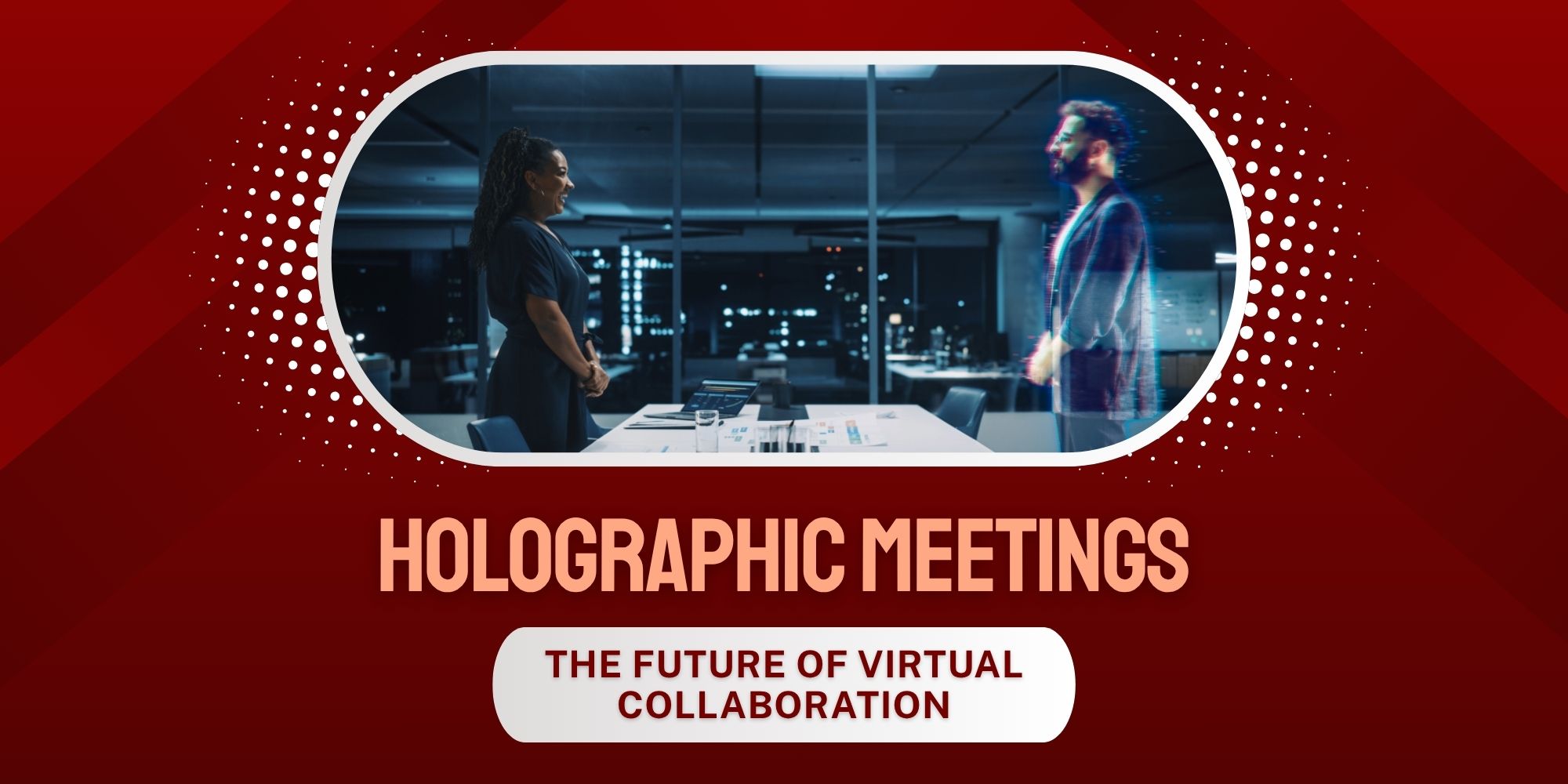
“Help me, Obi Wan. You’re my only hope.” This might be something you hear when you’re attending a holographic meeting because Star Wars fans span the globe and enjoy playing around (most of them). Welcome to the blog, everyone! Today we’re talking about something uber cool: holographic meetings. Can you even believe we’ve come that far already? We can’t either. If you can imagine holding someone’s entire person in your hand, then you’re on the right track. If you’re ready to get visible with it, grab a coffee, and let’s get going!
Virtual collaboration has come a long way in the last two decades. From phone conferences to video calls, each advancement has tried to bridge the gap between in-person and remote interaction. But the next leap is already taking shape: holographic meetings. By projecting 3D life-sized images of participants into a shared space, holographic technology promises to redefine what it means to meet virtually.
What Are Holographic Meetings?
Holographic meetings use augmented reality (AR) and mixed reality (MR) technologies to project digital representations of participants into a room. Unlike flat video feeds, holograms offer depth, perspective, and presence, making it feel as though colleagues are physically present—even if they’re thousands of miles away.
This technology builds on advances in AR headsets, spatial computing, and high-speed connectivity. With 5G and beyond, data-intensive holographic transmissions are becoming feasible, enabling smoother and more lifelike experiences.
Or super cool, in our opinion.
The Advantages of Going 3D
The primary benefit of holographic meetings is presence. Traditional video calls often lead to “Zoom fatigue” due to limited cues and disjointed eye contact. Holograms restore body language, spatial awareness, and natural interaction, which improves engagement and reduces miscommunication.
Collaboration also becomes more effective. Imagine engineers from different continents working together on a 3D model of a new product, able to walk around it, point at details, and make real-time adjustments. Or picture a sales team delivering a lifelike product demo to a global audience without shipping a single prototype.
For training and education, holographic meetings can simulate realistic scenarios, from medical procedures to factory workflows, giving learners a richer and more immersive experience.
Challenges Holding Back Adoption
As promising as holographic meetings are, several challenges need to be addressed before widespread adoption.
- Hardware Costs: AR headsets and holographic display systems are still expensive, making them difficult for small and mid-sized businesses to justify. This is probably the biggest issue, honestly.
- Bandwidth Demands: Real-time holograms require massive amounts of data. Without reliable, high-speed internet, experiences can lag or fail.
- User Comfort: Wearing headsets for long periods can be tiring. Developers will need to improve ergonomics and accessibility.
- Standardization: Without common platforms and protocols, holographic meetings risk becoming fragmented across proprietary ecosystems.
Real-World Progress
Despite hurdles, real-world applications are already emerging. Tech companies are experimenting with holographic telepresence systems for executive meetings, product launches, and high-stakes negotiations. Some startups are offering services that allow doctors to consult with patients as holograms, providing a more personal touch than traditional telemedicine.
Corporate training programs are piloting holographic scenarios to train employees in realistic environments. Universities are exploring how holograms can bring guest lecturers from anywhere in the world into classrooms as though they’re standing at the front of the lecture hall.
The Role of Emerging Technologies
Holographic meetings don’t exist in a vacuum—they rely on other emerging technologies. AI plays a role in rendering realistic avatars, enhancing gestures, and even translating conversations in real time. Cloud computing provides the infrastructure for data-heavy applications, while edge computing reduces latency to deliver smoother interactions.
As the metaverse evolves, holographic meetings could become a key component, bridging the gap between virtual reality and the physical world. Unlike fully immersive VR, holograms allow people to remain grounded in their real environment while interacting with digital overlays.
Looking forward, holographic meetings have the potential to transform remote work and global collaboration. As hardware costs decrease, internet infrastructure improves, and platforms mature, holography could shift from novelty to necessity. Businesses seeking to build stronger connections with distributed teams, clients, and partners will increasingly turn to immersive technologies to stay competitive.
What was once the stuff of science fiction is fast becoming a strategic tool. Just as video conferencing reshaped business in the 2010s, holographic meetings could define the next decade of collaboration—one where borders matter less, and presence is no longer bound by physical distance.
Thank you so much for reading! While you’re hanging around, why not check out some of our other blog posts. We cover a ton of topics from the Metaverse to emerging tech. Take a peek here. Until next time!
Contributor