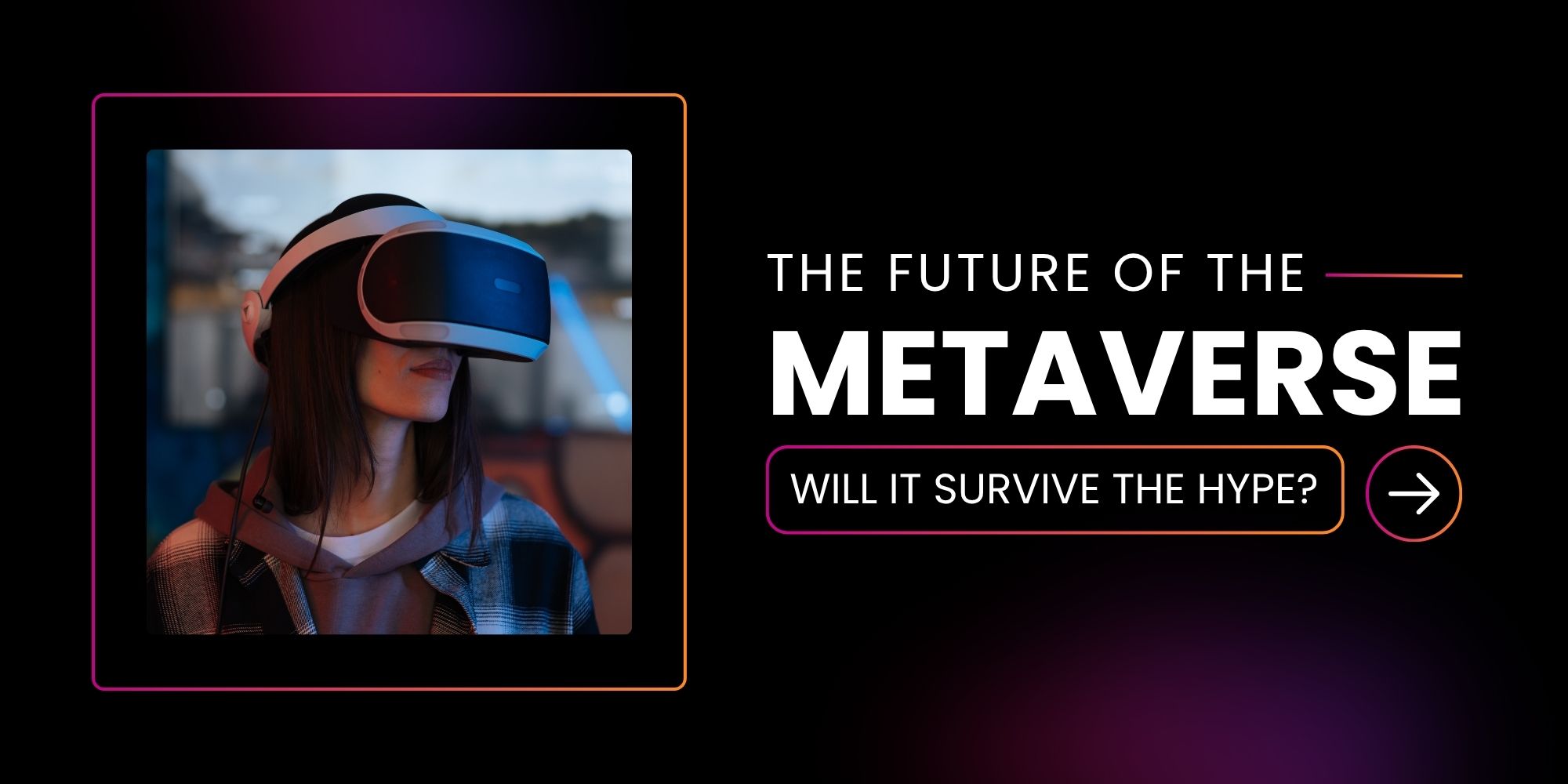
Hello, everyone, and welcome to the blog. Today, we’re talking about one of our favorite topics: the Metaverse. We’ve written a ton of posts about it, and you can find them right here on our blog. We invite you to pop on over there and take a peek around while you’re on the site and reading away. If you’re ready to dive on in, get comfy, get that mouse finger ready to scroll, and let’s get going.
A few years ago, the metaverse was everywhere (and we do mean everywhere—do you remember the weddings?). Headlines promised fully immersive digital worlds where we’d work, play, and socialize. Companies poured billions into virtual reality (VR), augmented reality (AR), and blockchain-powered platforms. Fast forward to today, and the excitement has cooled somewhat. Meta (the company behind Facebook), however, has seen a sudden rise in the sales of its AR glasses, so that might be a clue as to what people are starting to look toward more than VR. Let’s talk about why some projects have stalled, others have pivoted, and critics are asking: will the metaverse survive the hype?
Let’s take a closer look at where the metaverse stands now, the challenges it faces, and what its future might hold.
Where We Are Today
The metaverse isn’t dead—but it’s not the fully realized sci-fi vision we were sold, either. Right now, it exists in fragmented forms:
- Gaming Worlds: Platforms like Roblox, Fortnite, and Minecraft continue to thrive, blending user-generated content with social experiences.
- Enterprise Uses: Companies are experimenting with VR meetings, virtual training environments, and digital twins.
- Social Platforms: Meta (formerly Facebook) has invested heavily in Horizon Worlds (VR), though adoption has been slower than expected, likely due to the high cost of the hardware needed to participate.
Instead of one unified metaverse, we’re seeing multiple niche ecosystems developing independently.
Challenges Facing the Metaverse
Several hurdles stand between the current metaverse and the grand vision of a fully interconnected digital universe:
- Hardware Limitations: VR headsets are improving, but they’re still bulky, expensive, and not widely adopted.
- High Costs: Building immersive platforms requires enormous investments in infrastructure, content, and computing power.
- User Adoption: Outside of gaming, many users don’t see compelling reasons to spend significant time in virtual spaces.
- Interoperability: True metaverse experiences require seamless movement between platforms, but most ecosystems remain walled gardens.
- Skepticism and Fatigue: After the initial hype, many businesses and consumers are cautious about betting too heavily on the metaverse.
Signs of Progress
Despite the challenges, there are real advances worth noting:
- Enterprise Applications: VR and AR training simulations are proving effective in industries like healthcare, aviation, and manufacturing.
- Digital Twins: Companies use digital replicas of physical assets (factories, cities, supply chains) to model and optimize operations.
- Mixed Reality Growth: Devices like Apple’s Vision Pro are pushing mixed reality forward, blending physical and digital worlds more seamlessly.
- Blockchain and NFTs: While the hype around NFTs has cooled, blockchain still offers potential for digital ownership and secure transactions in virtual spaces.
These developments suggest the metaverse isn’t disappearing—it’s evolving into more practical, targeted uses.
Will the Metaverse Survive?
The short answer: yes, but not in the way many imagined. Instead of a single, all-encompassing virtual world, the metaverse is likely to grow as a collection of specialized platforms serving different needs:
- Entertainment and Gaming: Already thriving with massive global audiences.
- Work and Collaboration: Virtual offices and training tools will become more common in certain industries.
- Commerce: Brands will continue experimenting with virtual showrooms and digital goods.
- Education: VR classrooms and immersive learning environments will expand as technology becomes more affordable.
The hype cycle may have cooled, but innovation continues steadily in the background.
The Long-Term Outlook
Just as the internet itself took decades to evolve, the metaverse will take time to mature. The companies that succeed will be those focusing less on grand visions and more on solving real-world problems with immersive technology.
In the coming years, expect the metaverse to shift from being a buzzword to being a quiet but powerful layer of digital life—integrated into gaming, work, learning, and commerce.
While the metaverse may not match the sweeping visions of science fiction anytime soon, it isn’t going away. It’s adapting, finding niches, and slowly becoming more useful. The hype may have fizzled, but what remains could be more valuable: practical, purpose-driven applications that make life and work better.
What do you think?
We hope you enjoyed the read! Be sure and check out some of our other posts on the metaverse, VR, and AR while you’re here. Thanks for reading, and we’ll see ya next time!
Contributor